Featured
Just for Fun
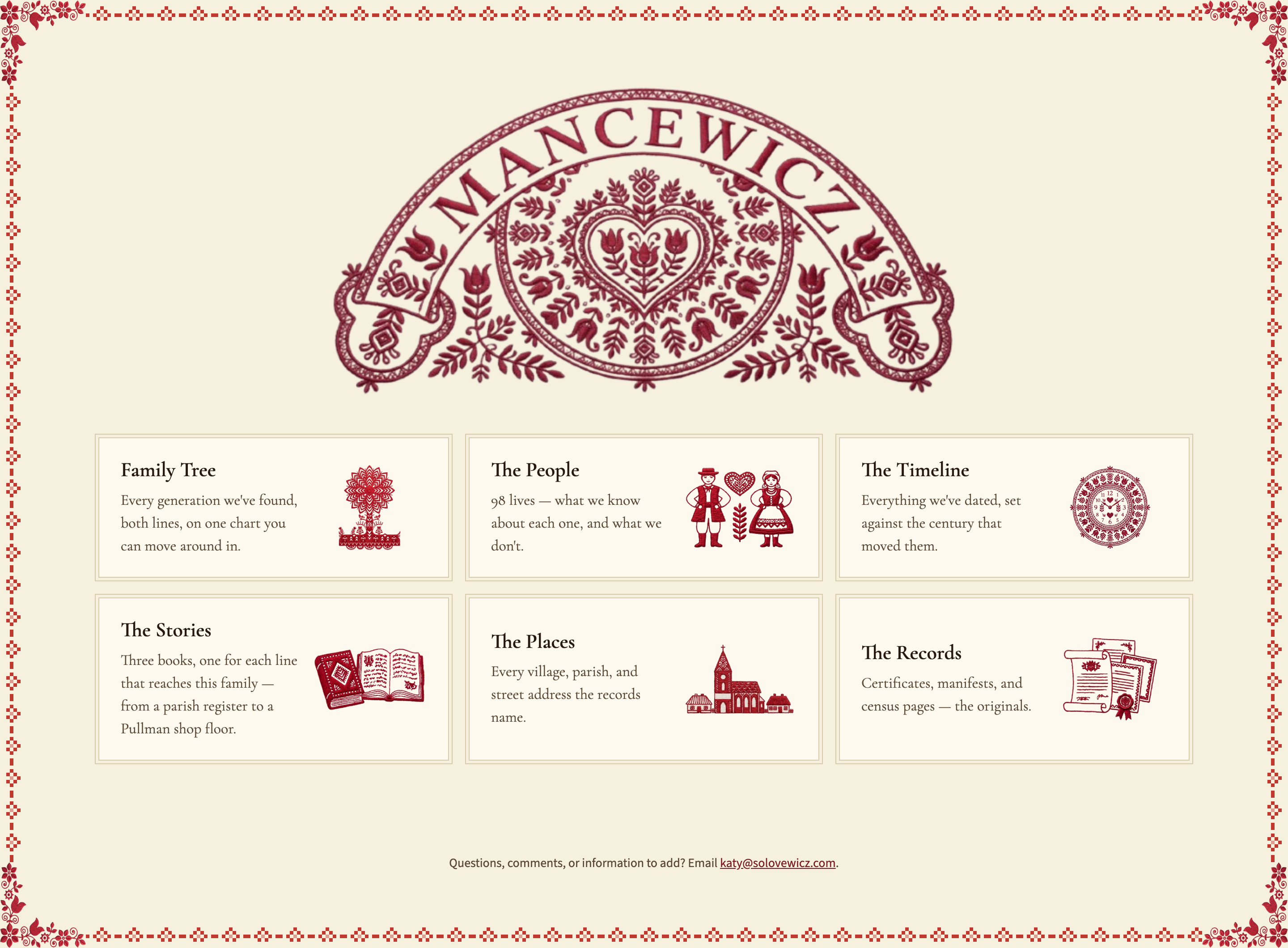
A family history site that treats genealogy like research: every fact cited, every dead end admitted, every living relative kept private.
Most family tree software asks you to trust it. Names and dates appear with no hint of where they came from, speculation sits next to certainty wearing the same font, and the one cousin who actually did the archival work gets flattened into the same database as everyone's guesses. I wanted the opposite: a family history site where every fact points at a record, speculative parentage is drawn with a visibly different border, and the research notes say plainly where the trail goes cold.
The Mancewicz Tree covers 98 people across three immigrant lines — Polish, Prussian, and Irish — that never crossed paths until Chicago. The content is files, not form fields: people, places, facts, and sources live as JSON and markdown in the repo, versioned in git, and every deploy syncs them into Postgres. Accounts, uploaded photos, and family anecdotes survive the sync untouched; derived data like relationships gets rebuilt. That means the research has a review trail, a diff history, and no way to silently drift from what the records say.
The tree itself is a custom chart you can pan around, with hourglass, ancestor, and descendant views and hover-to-trace lineage paths. Person pages read like a case file: a narrative summary, a mini-tree, dated facts each tied to a source, the name variants records actually used (census takers were not careful spellers), and the places they lived. A Leaflet map plots all 55 places the records name, from a Polish village no modern map shows to specific Chicago street addresses.
The access model is the part I think about most: the site is public, because dead ancestors belong to everyone descended from them, but living relatives render as unnamed placeholders until family members sign in. Relatives can contribute anecdotes typed or recorded — audio gets transcribed automatically — and everything publishes immediately, because the family historian should be a librarian, not a gatekeeper.
6 reviews
Intuitive, collaborative, and helpful — Katy knows how to solve your problem and has consistently provided numerous sources of knowledge and personal growth. Katy wants everyone around her to excel and goes out of her way to help people find their strengths. I would jump at the opportunity to work with her again.
Few people I've worked with in my professional career have brought as much positivity, wit, and creativity to the job. I've found her to be driven, adaptable, passionate, and able to focus on the details while not losing sight of the mission. Her professionalism and empathy make her a true joy to work with.
...is an incredible collaborator, always bringing curiosity, ambition, and a can-do attitude to every project.
Goes well with